 drone-reviewm.com
Owning and operating a drone can be both fun and rewarding. It allows you to remotely take to the sky and get a view of beautiful panoramas, as well as perform all kinds of small professional tasks like photography, delivery, and more. However, just giving every person in the country their own little flying machine and telling them to go wild would be incredibly irresponsible. After all, if a drone were deliberately piloted in an unsafe way, it could cause problems; not only with other drones in the air, but also with vehicles like airplanes and helicopters. That’s not even mentioning the possibility of using a drone for illegal or otherwise uncouth purposes.
To create an extra layer of safety, not to mention culpability, the United States Federal Aviation Administration utilizes the Remote ID system for all private and commercial drones. It’s this identification system that ensures the proper authorities can immediately discern who owns a drone and where it came from in the event it’s spotted flying in an unsafe manner. If, however, you wanted to fly a drone without worrying about all that red tape, would such a thing be permitted? The answer to that is yes, but not without a set of very particular conditions.
Remote ID allows authorities to identify a drone and its owner
First, let’s briefly cover what Remote ID actually is and how it works. A Remote ID system serves as a sort of invisible identification card for your drone. By accessing a drone’s Remote ID broadcast, you can determine a drone’s unique ID number, which can be linked to its owner, as well as its current location and altitude, and where it took off from.
This information is vital in determining whether a flying drone is where it’s supposed to be. For example, if a drone were delivering medical supplies in a dangerous area, its Remote ID lets everyone know that it’s associated with emergency services and supposed to be there. If a drone were flying in an unsafe manner or in a locale that it’s not permitted to be in, the Remote ID also helps authorities track down the operator.
Following the implementation of Remote ID laws in late 2023, most new drones come with Remote ID functionality built in. A Standard Remote ID drone can be freely controlled and operated in any permitted space, even if it’s not flying within the operator’s direct line of sight. For older drones or drones built from scratch, there are also broadcast modules that can be installed to retrofit them with Remote ID standards. However, a drone with a broadcast module is subject to more stringent rules, such as needing to be within the operator’s line of sight at all times.
You can fly without Remote ID, but only in specific ways and areas
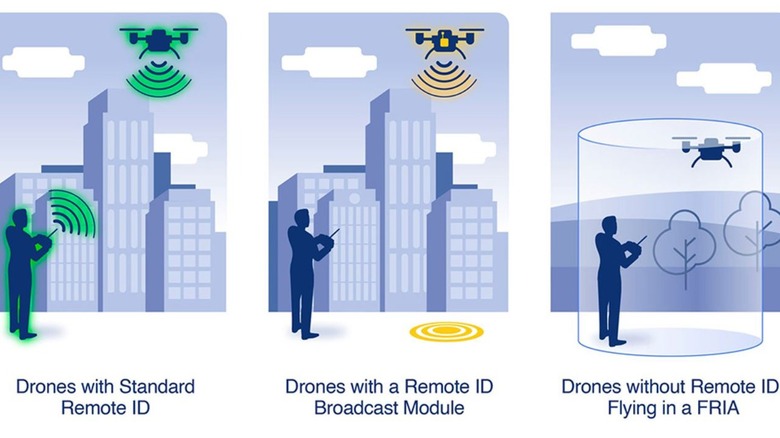
If you want to pilot a drone in an official or professional capacity, having a built-in Remote ID or Remote ID broadcast module is absolutely required. What if, however, you just wanted to take your drone out for a quick spin? Show off to your friends, get some casual pictures, enjoy a day out? The good news is that you can fly a drone that is not equipped with a Remote ID system. However, that comes with two very large and very important asterisks.
Firstly, a drone without a Remote ID system can only be operated within the boundaries of an FAA-Recognized Identification Area, or “FRIA” for short. A FRIA is a location that has registered with the FAA and met all of the requirements and regulations for safe drone operations. These include operational areas registered by local RC clubs, educational institutions like high schools and universities, and scientific institutions. The FAA maintains a country-wide map of currently-registered FRIAs if you’re looking for one.
Additionally, when operating a drone within a FRIA without Remote ID, you must have a clear line of sight with the drone at all times. Even if your drone has a built-in camera, it doesn’t matter: If you can’t see it, you’re breaking the rules. The drone must also remain within the boundaries of the FRIA, which includes both horizontal and vertical boundaries. You cannot fly any higher than the FRIA’s established vertical limit.
Source: http://www.slashgear.com/1626495/can-you-fly-drone-without-remote-id/
You may also like

